
Water Conservation
2026 Drought Update for Granger‑Hunter Water Customers
On April 21, 2026, the Granger‑Hunter Improvement District Board of Trustees selected Drought Level 2 based on current water conditions along Utah’s Wasatch Front.
Drought Level 2 includes voluntary water conservation measures, such as:
- Reducing outdoor watering through better scheduling and timing
- Increased public outreach
- Continued efforts to reduce water loss within the system
At this time, no mandatory water cuts or fee increases are being proposed. Mandatory measures would only occur under a Level 3 or Level 4 drought designation.
10% Less Water - Conserving Today, Protecting Tomorrow
Over the past several years, Granger‑Hunter customers have done an outstanding job using water wisely. However, more than 75% of our water supply comes from mountain reservoirs, and with this year’s snowpack at record‑low levels, additional conservation is needed. This year is different.
For 2026, Granger‑Hunter is focusing on the message:
10% Less Water - Conserving Today, Protecting Tomorrow
We are encouraging all customers to find ways to reduce outdoor watering by at least 10%. This may look different for each household, but some effective options include:
Ways to Save 10% Outdoors
-
Water less often, but more deeply
A typical run time for sprinkler spray heads is 15–23 minutes. By ensuring your run times are set correctly, you may be able to eliminate one watering cycle per week. For more information, visit slowtheflow.org. -
Set your controller for the season
Refer to the Utah Weekly Watering Guide, especially in the spring and fall when fewer watering days are needed. -
Check your system regularly
Because watering is best done at night, broken or misaligned sprinkler heads can go unnoticed. Inspect your system periodically during the day to ensure it’s working properly. -
Skip watering after rainy days
Skipping irrigation following rainfall can save $6 or more each time you use the “rain delay” button. If your controller doesn’t have this feature, visit utahwatersavers.com for information on rebates for upgrading to a smart controller. -
Look for turf conversion opportunities
Consider replacing traditional turf with water‑wise landscaping or more efficient turf varieties. Visit utahwatersavers.com for available programs and resources.
Conserving water now helps protect our current supply, reduce long‑term system costs, and may help delay or avoid more expensive future solutions, such as projects like the Bear River development. Additionally, less than 20% of water used outdoors is not returned to the Great Salt Lake, which is already near record lows.
Thank you for doing your part to protect Utah’s most valuable resource.
Water Conservation Plan Update - 2025
The Granger-Hunter Improvement District (the District or GHID) has developed this Water Conservation Plan to comply with the Utah Water Conservation Plan Act found in Utah Code 73-10-32. In response to ongoing concerns about the sustainability of both current and future water supplies, the District has created this plan to support the needs of its growing population. This report serves as an update to the District’s 2020 Water Conservation Plan.
In alignment with statewide goals established by the Utah Division of Water Resources (DWRe), the District has made significant progress in reducing per-capita water use over the past two decades. GHID successfully met previous statewide water conservation goals ahead of schedule and has continued to maintain water use at levels below those targets.
This report outlines the District’s updated conservation goals, compares them to regional benchmarks, and presents future projections based on population growth, climate trends, and conservation potential. The analysis demonstrates that GHID is not only meeting but surpassing regional targets, positioning the District as a leader in sustainable water use within the Salt Lake Valley.
Watering Guide
The State of Utah Division of Water Resources Weekly Lawn Watering Guide (below) offers customized watering recommendations for your area. The guide changes every week so check back often for updates!

The guide is updated weekly and more information can be found here: https://conservewater.utah.gov/weekly-lawn-watering-guide
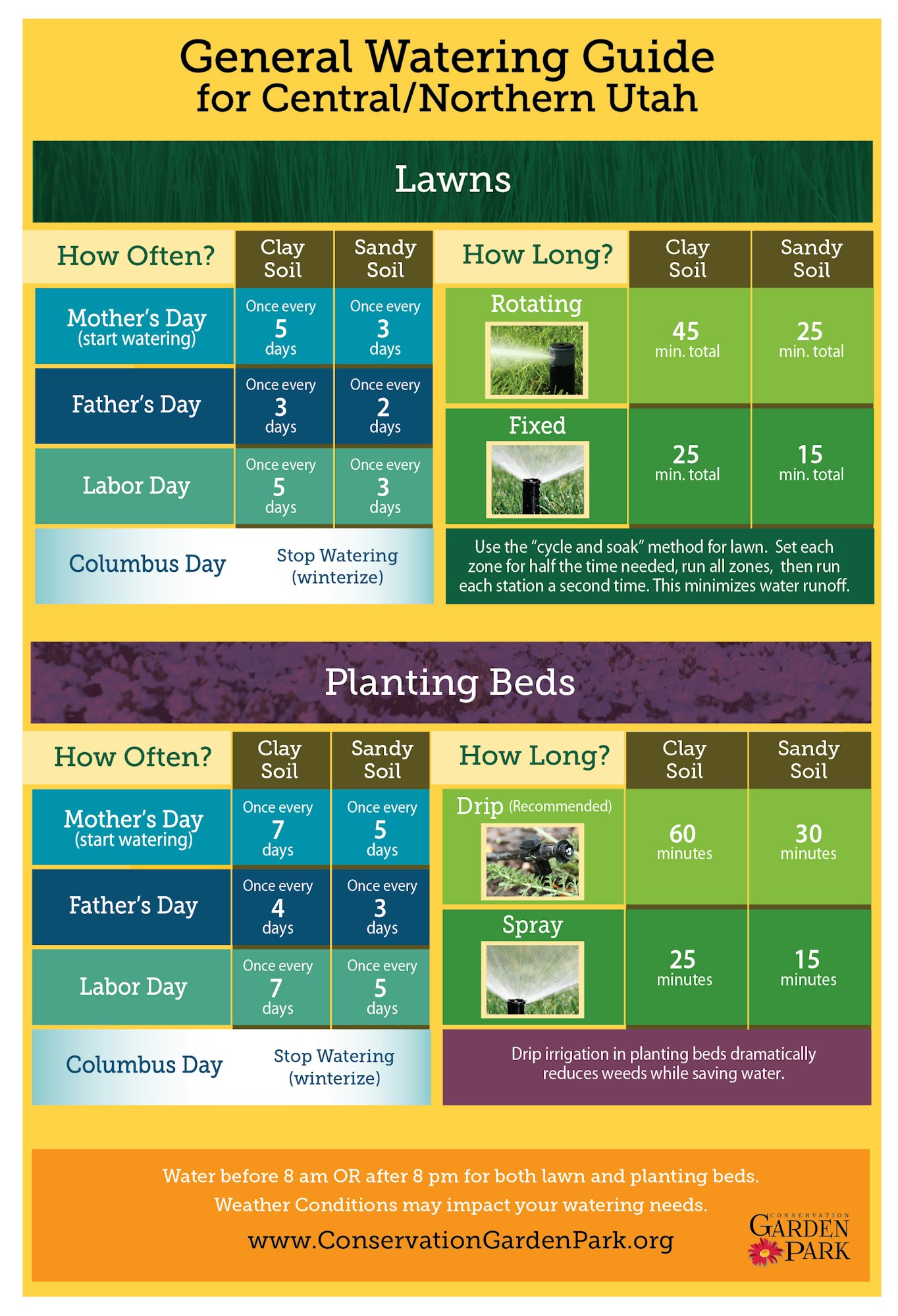
The general watering guide for northern Utah is also shown below
Things You Can Do to Conserve Water
- Water Less – It takes approximately 3,000 gallons of water each time you water the average quarter-acre yard. That can cost over $6 each time you water your grass, and possibly more if you have moved into the 4th Tier for water rates.
- Don’t water if it’s windy – If the wind speed is above 5 mph, much of the water will blow where it’s not needed and evaporate.
- Water at the right time – Don’t water between 8 AM and 8 PM. This reduces evaporation loss. While GHID has not adopted a drought outdoor watering schedule, you can help balance system-wide water use by watering on odd days in addresses with an odd number, and even days at addresses with an even number, while still following the weekly watering guide (number of days per week) above.
- Prioritize your watering – water trees, shrubs, perennials and annuals before grass.
- Raise your mower – set your blade at 3-4 inches high. This can help grass grow deeper roots and provide more shade to reduce evaporation loss.
- Get a rebate – rebates for smart irrigation controllers and low-flow toilets are available at SlowtheFlow.org
- Convert unnecessary grass areas to waterwise landscapes – visit SlowtheFlow.org and localscapes.com for localscapes information and how to receive cash rewards.
